
Routine low-stakes writing like journaling is the kind that’s ungraded and pressure-free. It improves students’ writing stamina and builds language fluency.
When students can get ideas down quickly, share those thoughts, and feel just as successful as everyone else in the room, it builds real confidence. That confidence, in turn, prepares them for longer, higher-stakes writing assignments down the road.
Journaling also supports social-emotional development. Middle schoolers are navigating peer relationships, identity questions, and strong emotions, often all at once. A well-designed prompt gives them a structured space to process those experiences in a healthy, constructive way.
The key? Not all prompts are created equal. The most effective ones invite persuasive thinking, personal reflection, informational reasoning, or imaginative exploration.
Let’s get to it.
Side note, we recommend the classic A5 Journal. Comes with a slot for a pen, its the right size, hardcover.
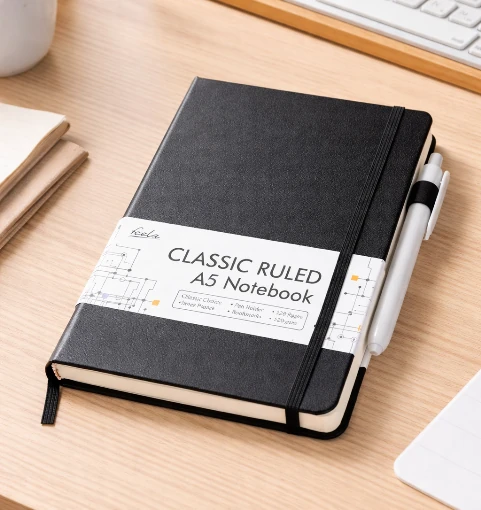
A5 Journal
Classic ruled notebooks are all blank inside with 128 lined pages (64 sheets), convenient for daily usage.
Self-Discovery and Identity Prompts
Middle school is fundamentally a time of asking, Who am I? These prompts help students explore that question with curiosity rather than anxiety.
- Reflect on how you’ve changed over the past year. What’s different about the way you think, act, or see the world?
- What are three core values that guide your decisions? Where did those values come from?
- Describe a moment you felt genuinely proud of yourself. What made it meaningful?
- What are you most passionate about right now, and how has that passion grown or shifted in the last few months?
- Is your cultural background or ethnicity an important part of your identity? How does it shape the way you see yourself and others?
- What skills have you worked to improve recently? What motivated you to keep going when it got hard?
- Write about what makes you you, the things that feel most essentially like your personality, interests, or way of moving through the world.
Social-Emotional Learning (SEL) Prompts
These prompts are perfect for helping students develop empathy, emotional vocabulary, and healthy coping strategies.
- Describe a time you felt anxious about something. What did you do to manage that feeling, and what would you do differently now?
- Write about a disappointment you’ve experienced. How did you eventually move through it?
- How can you tell when someone your age is feeling insecure? Do you think most people are more anxious than they let on?
- Describe a disagreement you had with a friend. What strategies helped, or could have helped, you work it out?
- What does it look like when someone is being inclusive? Write about a time you witnessed or experienced it.
- Think about a difficult moment from this past week. How did you handle it? What did you learn?
- What contributes to someone becoming a bully, and what do you think can genuinely help stop bullying behavior?
- After home and school, where do you feel the strongest sense of community? What makes that place feel safe?
Narrative Writing Prompts
These story-based prompts engage imagination while sharpening narrative skills like pacing, character development, and descriptive language.
- Tell about a time you were afraid. What happened, and how did it end?
- You show up to school one morning and there are no adults anywhere. What happens next?
- Write a story about moving with your family to a completely new country. What do you leave behind? What surprises you when you arrive?
- If you could go back in time to any moment in history, where would you go? Tell a story about what you find when you get there.
- Write a story that begins with the first line of your favorite song.
- You find a map that leads to hidden treasure. Write the story of your search.
- Write a mystery about something that goes missing at your school. Who are the suspects? How is it solved?
- A door in your school has always been kept locked. One day, you walk past and discover it’s open. Write a story about what happens next.
- Write about your happiest memory — the kind you want to keep forever.
- You meet a genie who grants you three wishes. Write the story of what you choose and what happens as a result.
Creative and Imaginative “What If” Prompts
Sometimes the best writing comes from the most outlandish scenarios. These prompts free students to play.
- If you starred in a TV show about your life, what would it be called? What genre would it be — comedy, drama, thriller, reality? Summarize one episode.
- If you were an animal, what would you be? Write a story from that animal’s perspective for a day.
- You wake up tomorrow with a completely silly superpower that somehow makes you internationally famous. What is it, and how does it happen?
- Imagine you’re the first person to set foot on Mars. What do you see? What do you explore first?
- You have a computer that can be programmed to handle any of your regular responsibilities. What do you assign to it and what do you keep for yourself?
- Create a new school subject that doesn’t exist yet. What would it teach? Why does it matter?
- Write a scene where two animals are watching humans do something and quietly judging them. What are the animals thinking?
Informational and Opinion Prompts
These prompts build the kind of structured thinking that transfers directly to academic writing and real-world reasoning.
- Compare and contrast two school subjects, what do they have in common, and where are they completely different?
- Write about why eating healthy matters. What do you actually know about it, and what questions do you still have?
- Why is it important to get enough sleep? Write about the effects of going to bed at a consistent time each night.
- Some people say the legal driving age should be lowered to 14; others say it should be raised to 18. Where do you stand, and why?
- Should everyone be required to learn a second language? Make your case.
- Should governments do more to discourage smoking and vaping? Explain your thinking.
- Write about the job you think you’d like to have someday. What do you know about it, and why does it feel like a good fit?
- What is the greatest challenge students face today?
Goal Setting and Future Planning Prompts
These prompts help students think intentionally about where they’re headed and what it takes to get there.
- Describe your ideal life 15 years from now in as much detail as you can. What’s one thing you could do every single day to move toward it?
- Write about three goals you have, one for school, one for your personal life, and one that’s a stretch goal you’ve never told anyone.
- If you had one full week with no obligations and no restrictions, what would you want to learn? Why that?
- Describe a person who influenced your life in a positive way. What did they do, and how has it changed you?
- What do you want adults in the future to understand about what it’s like to be young right now?
Reflective Daily Check-In Prompts
Short, consistent reflection builds self-awareness over time. These prompts work well as daily warm-ups or end-of-day closers.
- What is one thing that went well today that you didn’t expect?
- Write about one new thing you learned this week, in class, from a friend, or just from paying attention.
- What are three things you’re genuinely grateful for today? Be specific.
- Is there someone in your life right now who could be a mentor or guide to you? What would you want to learn from them?
- Glass half-full, glass half-empty: Pick a situation from your week and describe it first with a positive lens, then with a negative one. Which felt more true?
Conclusion and a Note on How to Use These Prompts
Keep it low-stakes. These work best when they’re ungraded and framed as thinking practice, not performance. Also give students a choice. Offering two or three prompts at a time lets students pick what resonates and invested writers write better.
Protect their privacy. Let students write “personal” at the top of any entry they’d prefer to keep private. This makes the space feel genuinely theirs and allow them to share what feels right.
Finally, checkout our guide on the best writing tablets for teachers.
Discover more from Teach and GO
Subscribe to get the latest posts sent to your email.